Popular Ammo Calibers
Many years ago, I downloaded a spreadsheet titled listoflists from JWR's website, SurvivalBlog.com. It's not a bad place to start if you're starting to think along these lines. I always find it interesting to peek into the mind of someone that is hyper-focused on the security aspects of a post-SHTF society. Surprisingly, JWR's lists are broken down into a granular and easy to follow tab naming structure. There are many practical ideas contained in this document; some of which may or may not apply to you or me depending on location (urban vs. suburban vs. rural) and mindset when approaching this topic. There are some tabs that are a little over the top for me, but these are his lists so who am I to judge. He is former Army and I believe his first wife was a nurse, so that explains some of his information and thought processes.
Several of his topics stick out to me given my own proclivities and the current season, which are ammo and reloading. I've discussed reloading previously, but my brother dropped off his 12-gauge press so I'm starting to figure that out. It's also late fall, early winter and my first duck hunting trip is right around the corner. So, that leaves the topic of this post, popular ammo calibers.
Now, JWR mentions ammunition in passing on his Barter and Charity List tab, but doesn't specify calibers. He only says, 'Ammo of various calibers'. So, that got me to thinking, which calibers?
Cue the research... Here's what I found. The following images were found on the Knowledge Glue website. According to this site, the top five calibers are: 9mm, 223/5.56, 45 ACP, 12 gauge, and .22 LR. Here's their full top 20 list of calibers in the United States as of 2015:

Nothing really surprising there. Their article also contained a full list of 91 tracked calibers (by sales). However, the data set that was of the most interest to me was where they broke down each state's top five calibers. This is important information if you are planning on adding ammunition to your stores of barter and charity items as JWR suggests.

Because I'm a curious fellow, I clicked a link at the end of their article to find out the top manufacturers by state. This is also important information particularly if you plan on having spare parts available for barter and trade. Here's what Knowledge Glue had for this particular topic:

When they compiled their data, they did make note that what they were seeing for North and South Dakota was inconclusive so those states were not included. Here are the links so you can read the Knowledge Glue articles in their entirety. Also, take this information with a grain of salt as these articles were written in 2015. Granted, I don't think there's been some kind of massive shift in the data during the ensuring two years.
What Are the Most Popular Calibers in the US?
What Are the Top Firearm Calibers and Manufacturers by State?
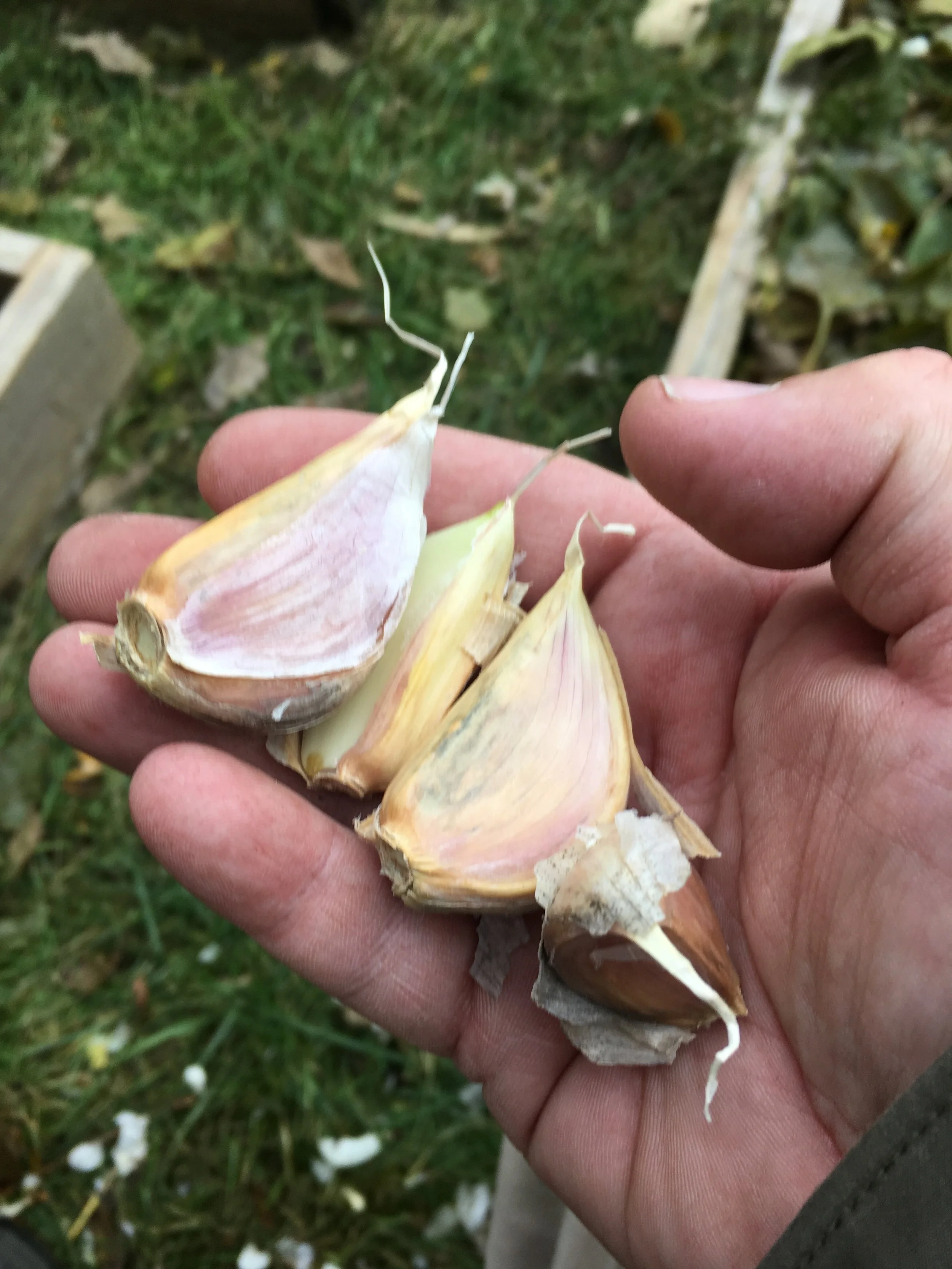
Garlic is in the Ground
Fall has definitely arrived here in central Ohio and who would I be if I didn't start planning for it before summer was even over! I found a vendor at the downtown farmer's market that was selling these massive garlic bulbs that he stated were German Hard Neck Garlic. I've done garlic in the past and determined that hard neck varieties work better than soft neck in my cold hardiness zone (6a). So what's the little urban farmer to do... buy six of these massive mothers of course!

German Hard Neck Bulb
Now, as a reward for the change of seasons, in addition to removing the last vestiges of plant matter from the raised garden plots, I also get to start prepping and planning for the next growing season. Well, technically, I removed the exhausted plants a few weeks ago, but who's counting. This weekend however, I got the garlic cloves planted. It didn't take long to do this. What actually took some time was getting all of the leaves from the crap scrub trees out of the bed and surrounding area.
Man I can't wait to cut those bastards down and turn them into some nice split firewood!
Any way, this year I planted German Hard Neck Garlic. Look at the size of these cloves!
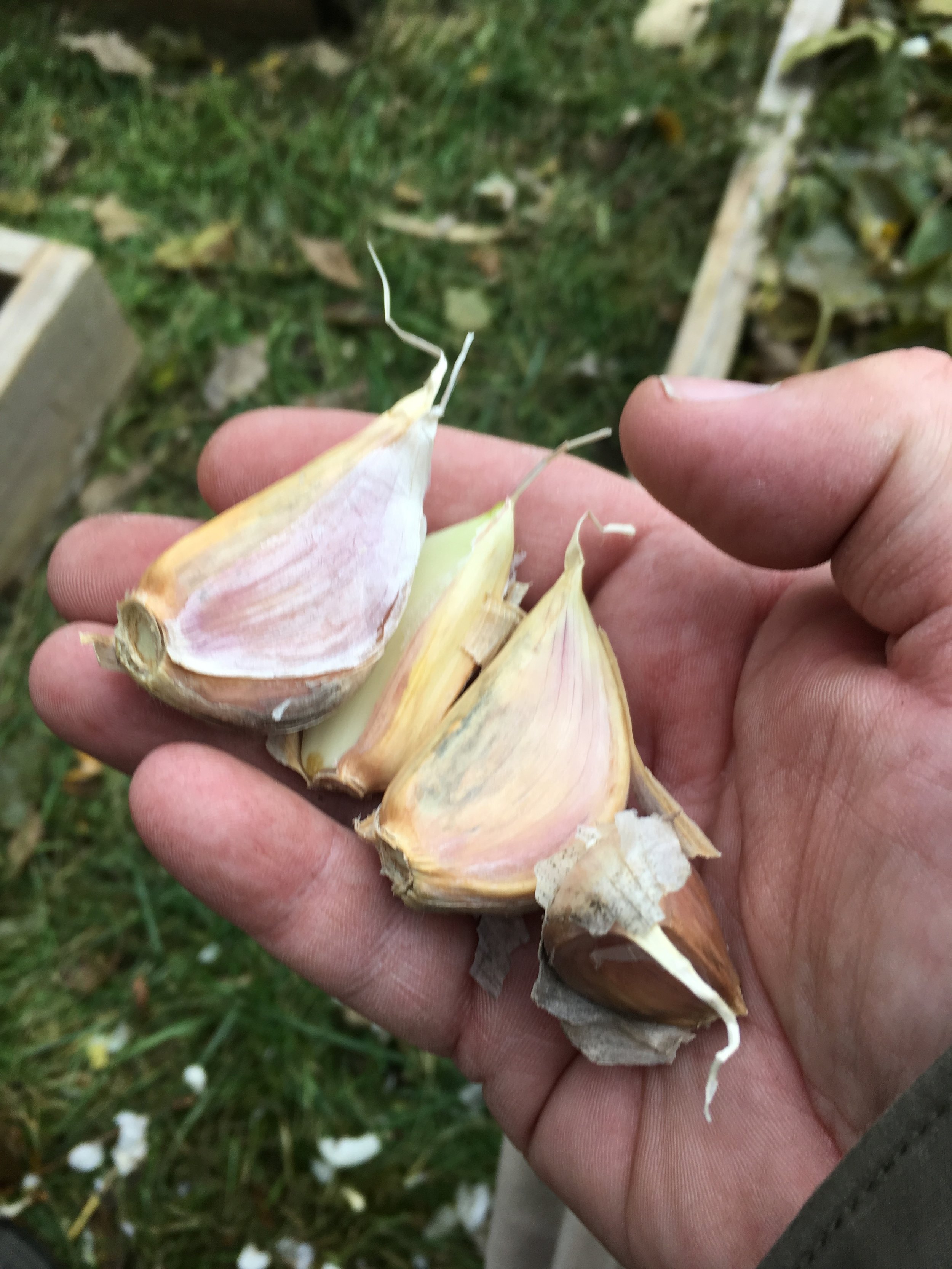
German Hard Neck Cloves
Amazingly, there were only eight cloves in the bulb. WOW!
In the northern climes, garlic performs best when planted in the fall and is then covered with a nice bed of straw. I like to plant my cloves so that the root end is approximately 2-3" deep and each clove is about 6" - 8" apart.

Interestingly enough, I made my holes for the cloves before I realized there were only 8 cloves per bulb. Oh well. Anyway, I also chose this particular bed because it houses my asparagus crowns and they needed to be over wintered with straw as well. Two birds, one stone baby!

All that green leafy stuff is the first year asparagus
The trick with asparagus is basically you have to plant it and wait at least one growing season, possibly even two or three depending on a variety of factors. Things like drainage, heat, and sunlight all will determine how long it takes your crowns to mature. The family loves asparagus so I planted it this year in the hopes that it is ready next year. Once it's established though, you're ready to go. You just can harvest anything the first year.
Back to garlic...
As I was saying, I like to plant my garlic cloves with the root end 2" - 3" deep. These cloves were so massively huge that the pointy tips were almost above grade! Once they were in the ground, I covered them with more dirt and then unleashed the straw!
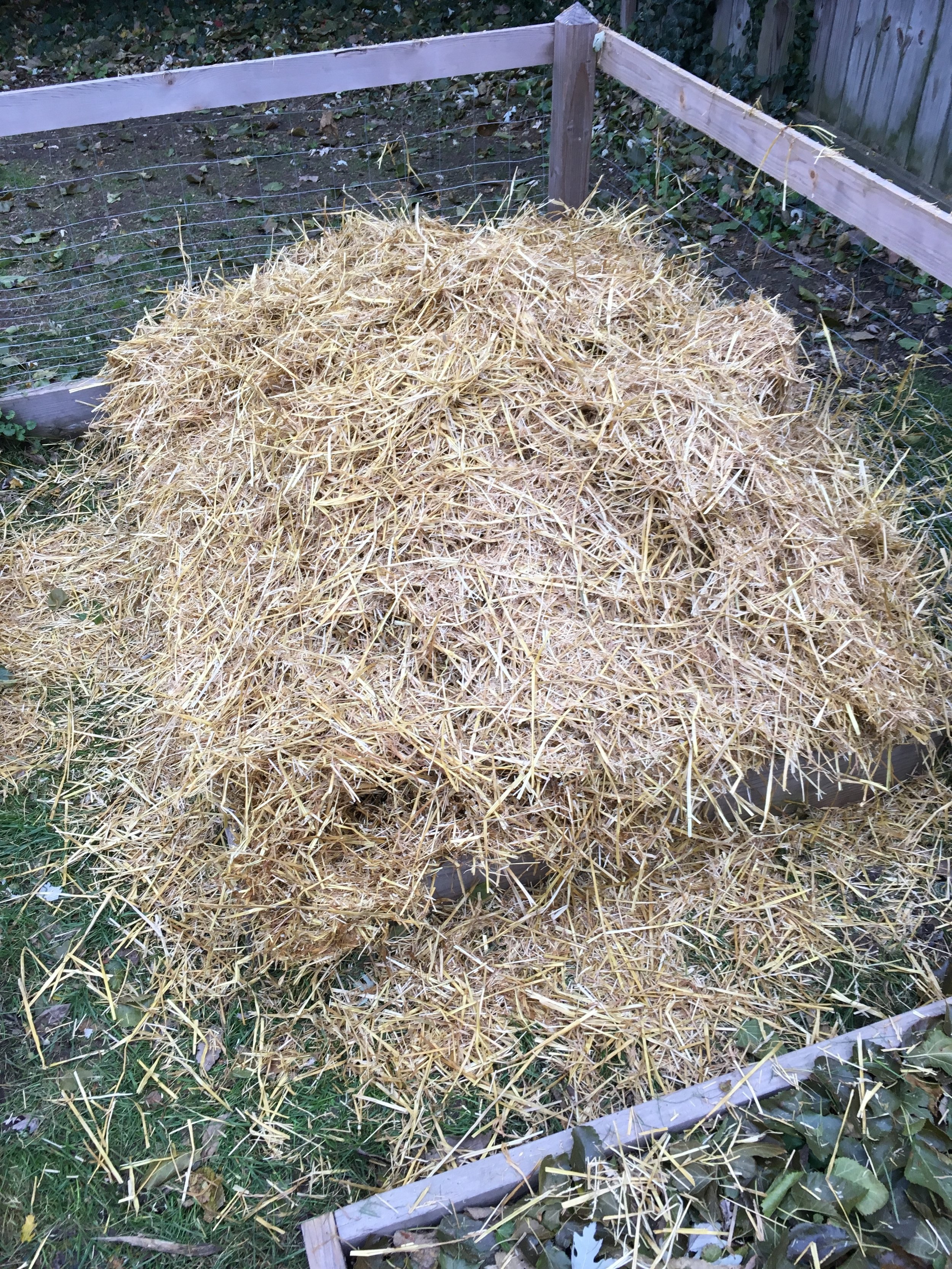

In the spring, I'll lay out some more newspaper over the grass path ways and fill that with about 2" of rock. No more weed eating in the garden for me! You'll also notice that I left the leaf matter in the remaining beds. It's basically free organic matter and it'll get chopped up and turned in to the beds by the tiller in the spring.
Vaccines and Other Controversial Opinions
Some time ago, I signed up for the Orthomolecular News Service. It comes out every couple of weeks and generally espouses healthy living and vitamin supplements. The doctors there will chronicle how certain patients were treated (niacin, vitamin C, etc.) and how the patient responded. Today's newsletter was on vaccines. This is a serious and controversial topic for many. Here's the link to their article:
Vaccine Adjuvants and Excipients
One of the reasons I wrote Part I of the series, and a reason I sought out and found this news service, is because I was disturbed by the high rates of incidence for all manner of neurological and gastrointestinal disorder. Here's what I was staring at at that time:
- My father died of pancreatic cancer in 2005
- My mother was declining due to dementia (eventually succumbing to colon cancer in 2015)
- Neighbor across the street had twin sons (one developed autism (high functioning) and the other did not)
- Neighbor down the street had a son with severe autism (non communicative at age 12 except via limited sign language)
- Neighbor next door developed Celiac disease
- Wife's mother died from Parkinson's
And on and on and on it went...
Now, you're certainly entitled to your opinion and you can believe what you like... but my opinion is that there is a connection between the foods we're eating, coupled with the manner in which the vaccines are concocted and administered, and the visible and tangible issues we're are seeing in the neurological and gastrointestinal medical spaces.
There... I said it.
Emergency Supplies

Image from Weather.com
I've been reviewing my Preparing to Prepare piece (work in progress - non fiction) and thinking about the hurricanes that hit the United States and its territories (Puerto Rico) lately. Think about it... In a span of 45 days:
- Hurricane Harvey hit Texas/Louisiana on August 26, 2017 (90 dead)
- Hurricane Irma hit Florida on September 10, 2017 (134 dead)
- Hurricane Maria hit Puerto Rico on September 20, 2017 (90 dead)
- Hurricane Nate hit Louisiana/Mississippi on October 8, 2017 (40 dead)
Millions of families are/were without power, uprooted, and devastated. Their possessions were flooded, blown down, or washed away. Sadly, 354 people lost their lives to these storms. Now, most of these deaths were the result of failing to evacuate (where possible), shabby building standards, poor planning, and even worse decision making.
But what about the survivors... the millions without power and the utterly helpless?
Many of the companies I frequent for my various supplies and interests sent long haul trucks and cargo containers full of supplies to the devastated regions to help with the relief effort. As a result, this has left the rest of us facing shortages when it comes to new purchases and the replenishment of exhausted consumable resources. Seeing an item online tagged with an 'Out of Stock' message has become a common occurrence for me.
In the non-fiction book, I take the concept of general preparedness and break it down into three distinct duration's; minor (1-week or less), moderate (1-3 weeks), and major (4-weeks or more). Each of these hurricanes reached a 'Moderate' rating at different stages of its lifecycle in certain parts of the Caribbean, Central America, and North America. Several of these storms, given my duration classification, are 'Major' disturbances.
So what do you do if presented with this scenario?
Here's what I put in the book:
I point to this weather related issue because this puts Hurricane Matthew in the ‘moderate disruption’ category. Knowing what they are experiencing, it begs some of the following questions. Do you have enough of the following to last two solid weeks for a family of four?
- Food and Water
- Fuel
- For a vehicle to go 50-100 miles (one-way) to get supplies?
- For the portable generator (assuming you have one)
- For the house generator (e.g. Generac, assuming you have one that is not on a city feed)
- For cooking meals and boiling water (propane, white, or charcoal - assuming you don’t have a gas stove being fed by the house generator)
- Consumable supplies (batteries, candles, toilet paper, feminine supplies, etc.)
- Medications
Two things to consider with a whole house generator (should you be thinking about procuring one):
- If the city is without power and you are hooked into a city fed gas line, you will be without gas due to the pumping station lacking power.
- A week is just about enough time for people to start panicking and doing things they never would have thought themselves capable of doing. Two weeks without reliable food, water, and electricity and you’re bound to have a run in or two with someone more desperate than you.
I tell you these things because a home lit up like Christmas against a backdrop of sheer darkness is a tempting target… but we’ll get to the concept of discretion and security a little later.
Additionally, if you flesh out the last item on the previous list, Consumable Supplies, you might have a list that looks something like:
- Batteries (varying sizes)
- Candles (long burning)
- Toilet Paper
- Feminine supplies
- Spare toothbrushes/toothpaste
- Soap and shampoo
- Deodorant
- Dishwashing soap
- Laundry detergent
- A method for washing/drying clothes
- Pots/pans
- Paper plates, cups
- Plastic cutlery
- Matches/tinder
Granted, food and water are consumable products too, but I’ve made those separate line item categories for the simple fact that you need those two items to actually live and survive. These items are just for comfort.
For me, the preliminary questions and various scenarios present in this Introduction alone are enough of a reason to begin seriously thinking about preparing to prepare. What do you think?
Perhaps, the millions without power wouldn't be nearly as helpless, and most aren't, if they had planned accordingly for just such an event. I know, that seems harsh and a tad bit like Monday Morning Quarterbacking, but it's true. I cannot understand why people still believe some omnipotent government apparatus is going to save them. I see videos of people boarding up the beach house windows and then sitting inside as a massive hurricane closes in. My only thought is, "Great, you saved your windows. Got any food or water in there?"
Sadly, the answer is usually, 'We ran out', 'We thought they'd get here sooner', 'We didn't think it would be that bad', and 'I'll never do that again'.
FEMA says every American should have a 3-day supply of food and water in case of an emergency. I say screw that! 3-days isn't enough for the people affected in Texas, Louisiana, Mississippi, Florida, Georgia, South Carolina, North Carolina, or Puerto Rico.
After reviewing that piece of my Introduction some weeks ago, I started a new reinvigorated effort to procure some things. Where did I turn... to my handy JWR inspired LISTS of course! The image below has been cobbled together from multiple lists actually (certain personal data removed of course). I'm providing it here as context given the previous write-up concerning duration's.

The center column labeled as 'Procured' has conditional formatting applied to it. If the cell for the row contains a value, a 'Y' for example, then the entire row is shaded in green indicating I no longer require that item and have achieved that goal.
Given the current state of affairs nationally and globally, can you really afford not to start acquiring even the most basic emergency supplies?
Continued NK Threat of EMP
As part of my research for the book series, I read through the entirety of the Report of the Commission to Assess the Threat to the United States from Electromagnetic Pulse (EMP) Attack, as well as the shorter Executive Report. The manner in which an EMP works, what the after effects would be, as well as estimates on the casualties are all detailed in those two documents. Some time ago I placed both of these documents on my Research Downloads page for everyone to access.
I cannot stress this enough, you need to read these documents. Not everyone will fully understand all of it as they can be quite technical at times, but you should read them all the same. Readers need to make their own determinations as to how to they wanted to incorporate that knowledge into their daily lives.
That being said, it seems, that two of the reports' authors were recently on Capitol Hill to discuss the original assessment contained in the report and breathe new life into this potential cataclysmic problem given the rhetoric coming from North Korea. Here's the article that discusses their testimony and what we as a nation are potentially facing: Congress Receives Bone-Chilling Warning About the Results of a North Korean EMP Attack.
For additional information (Cliff Notes style), scroll down and read my post from August 13, 2017, A Note from the Author Regarding EMP. In that post I explain my need to include a disclaimer regarding the true effects of an EMP in Part IV of the series. After reading that, continue to scroll down to my March 6, 2017 post, EMP Related Information. In this post, I quite literally copied and pasted the text from Part III where I breakdown the science of exactly how an EMP works to shut down electrical devices, cars, the grid, etc.
The more information and knowledge you have, the better off you and your family will be.
Mini Meadows, Switchgrass, & Hugelkultur
Kind of a wide-ranging post today. In a nut shell, I've been doing some reading and research in an effort to pack Part IV of the series with some additional concepts and useful ideas. On tap today, we have Mini Meadows, Switchgrass, and Hugelkultur.
Spoiler Alert: The bulk of the characters in Part IV pretty much spend the entirety of the book on a journey that sees them leave the farm in McArthur, Ohio and head west toward the far end of the central plains and back again. Fear not though, the home fires are kept burning with a nice complement of characters too. I tell you this so you'll understand how and why these three ideas are related. Given the locations of scenes and the interactions the characters have, each of these concepts has a degree of validity as it pertains to beneficial knowledge transfer to locals struggling to survive 20 years after an EMP.

Mini Meadows:
What is a mini meadow? Pretty much what it sounds like actually. The concept is pretty easy and straight forward... take some open space and plant native plants/grasses in an effort to maintain and/or increase your local population of pollinators. The general precept being the restoration of native prairie in little way stations for local populations of insects and some migratory species.
Anyhoo, I found this article some time ago and forwarded it to a friend that has some land outside of the city. The next weekend he started incorporating some of the concepts to maintain his bee hives. When I last checked in with him, his hives responded well and he attracted more butterflies than he knew what to do with. So, that's good. Here's the link:
Switchgrass:
The concept of biomass produced ethanol has been kicking around in the back of my mind ever since I took an interest in biofuels as a means to produce fuel for vehicles in an off grid, self-sufficiency type of way. Well, to be fair, I've been interested in switchgrass biofuels and gasifiers, but since I covered gasifiers in Part III, I figured I'd try and include switchgrasses in Part IV.
Once upon a time, the American plains were covered with these tall grasses. The Bison that inhabited the land used the tall grasses to evade predators, birth their calves, and as shelter from nature's fury. Switchgrass is extremely hardy and one of its hallmarks is its deep root system.
Just look at the image below! With a root structure like that it's no wonder the grasses can survive severe drought and fire!

Image from Wikipedia
Now, to get to an end product, that being liquid fuel, you might need a better than average understanding of chemistry. Here's a couple of links to give you some background on switchgrass:
- Wikipedia: Panicum Vigatum
- eXtension: Switchgrass for Biofuel Production
- Scientific America: Grass Makes Better Ethanol Than Corn Does
Hugelkultur:
This is a 'no dig' type of gardening and translates as 'hill culture' or 'hill mound'. In a nut shell, it represents one of the many forms and concepts of permaculture gardening. The idea behind hugelkultur is so simple it's almost laughable. Basically, dig a hole, place some timber in the hole, cover the timber with additional compost like material, cover that again with good soil, then seed the hell out of it.
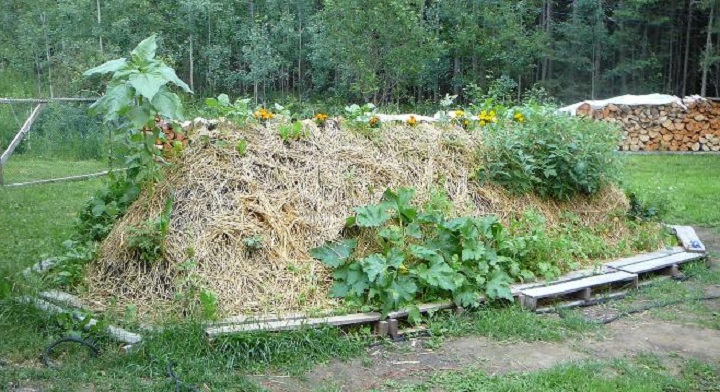
Image from Permaculure Magazine
My friends over at The Prepared Homestead have a YouTube channel where they discuss what they did and you can see one that is starting to produce. Here's the link for that: Prepared Homestead Channel.
Here is some additional information on hugelkultur as well:
- Raised Bed Vegetable Gardening With Hugelkultur; An Introduction To Growing Vegetables In Timber And Soil Heaps
- Best Way to Improve Your Soil: Hugelkultur Update
- The Making of a Hugelkultur Garden Bed
The concept of hugelkultur appeals to me greatly both personally and for my fiction because it's an easy concept to grasp, implement, and write about plus it can be done just about anywhere... even say in southwest Oregon where a character happens to be travelling through.
Water and Fuel
An interesting topic/discussion came up the other day on one of the forums. Well, it wasn't so much a discussion as it was a suggestion. A great many of us were dumb struck by the simplicity of the suggestion and we're kicking ourselves for not having thought of it prior to the post.
Scenario: The shummer has happened and you are either trying to get home, get to you BOL, or just trying to make do within your AO. It hasn't rained in some time and water is scarce or you're running low on water in general. Now what?
Ever seen one of these on the side of a school or a commercial property?
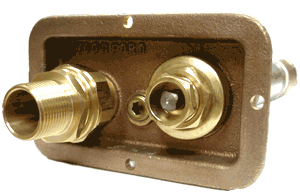
That, my friends, is a tamper resistant spigot, or sillcock. If you happen across a building that's greater than a story or two, you might be able to activate the spigot and get water provided you have a sillcock key... and someone hasn't beat you to it!

You can find these handy little potential life savers at places like Wal-Mart and Amazon for anywhere between $3 and $7. I was so impressed with the suggestion on the forum I bought a two-pack!
That, of course, got me to thinking... what about fuel?
Well, first off, obtaining fuel in a grid down type of scenario presents you with a variety of issues. The first of which is morality. I guess taking water would be a moral dilemma as well, but 'requisitioning' fuel is more likely to get you shot for looting than tapping a water spigot and filling a canteen or two.
Let me be clear... DO NOT STEAL FUEL!
There, now that I addressed the legal aspects, here's what I found that could aid you in tapping your own underground tank if you lose power.
I've got two suggestions. One is a DC powered fuel pump that can be attached to a car battery and the other is a hand crank. Both can be purchased from places like Northern Tool and Tractor Supply for about $160.


I am still stupefied at how simple the suggestion of a sillcock key was... I'm friggin' surrounded by those tamper resistant spigots all the time especially when I volunteer to work on community gardens at the local schools. I guess I was so preoccupied with installing rain barrels that I never put two and two together.
Sometimes... Occum's razor is real equalizer...
Waterfowl Hunters Should Delight
DU released their estimates for the various migratory flyways... should be a good winter out there in the blinds and on the water. Here's the article:
I am trying to convince friends to come with me down to Louisiana for a multi-day hunt so we can try out the Mississippi flyway. Had a buddy up in MN set to host us last year, but that fell through. So, given the option of freezing my ass off in MN or trying my hand down at the gulf coast... I think I'll try the gulf coast. Maybe one day we'll make it to MN.
I've spent almost the entirety of my life hunting the Atlantic flyway... to varying degrees of success of course. A change in flyway could be fun.
Greenhouses... Greenhouses Everywhere!
Got an email from National Geographic and one of the articles was about how the Netherlands is the second largest exporter of food in the world... second only to the US and we have 200%+ more land. That's crazy!
How'd they do that?
Greenhouses! They're everywhere and they are multistory, robust, and technologically advanced! I like playing in the dirt and if I could do it all over again I'd probably been some kind of a farmer/homesteader living somewhere semi off-grid but I've always intended to supplement the farm income with greenhouses.
This article just makes me want re-double my efforts to get out of the office rat race.
Here's the link: This Tiny Country Feeds the World
I only get one free article a month because apparently I don't have a subscription (thought I did) so hopefully the link works for everyone.
Daughter's Dilemma - Birth of a Conservative
Got a text from my high school daughter proclaiming, "OMG dad! My AP Gov class is full of screaming liberals!"
After a full belly laugh at her expense, my first thought was, "Welcome to the world in which we live, kid."
Over the course of dinner she explained her comments further. I mostly listened as she vented... because that's what fathers with emotionally charged daughters do. When she was done, I offered the following as sage advice:
1.) Don't pick a fight, intellectual or other, unless you know you can win.
2.) If someone is espousing a specific view point for which you disagree, just listen and let them get it out of their system without interrupting or offering rebuttal. That being said, before you wade into the discussion and offer a counter argument, make sure you are armed with information and facts that back up your position.
Later that evening, I sent her an email full of links and starting points so she could start making her opinions stick in a political debate [provided below].
3.) Any position that runs counter to the Constitution is not a fact. It is actually a wish, or a dream, and is definitely a fallacy.
As an example of this statement, I pointed to the Electoral College and the post I created regarding that topic. Use this Blog link and scroll down to the January 10, 2017 post titled: The Electoral College - Working as Designed.
4.) Any discussion that becomes emotional, walk away. Passion is good, but passion isn't truth and passion isn't always factual. Walking away may enrage them further or give them the sense that they've won something, and that's fine. You won't be changing their mind any time soon anyway so wait until they calm down and are capable of having a rational conversation.
After the discussion she stated that she was nervous about speaking up because she didn't feel like 'she knew enough'. Good thing she has a dad that likes research... and conservatism! So I sent her an email with the following information (hopefully she uses the information):
And here are links to resources to help you form your opinion. At a minimum I'd start with twitter feeds and the Hillsdale online courses. The courses are about 10-20 minutes in length and will give you a good conservative foundation with which to start forming your arguments and rebuttals.
Dennis Prager
@dennisprager (twitter)
https://www.prageru.com/
http://www.dennisprager.com/
Hillsdale College
https://www.hillsdale.edu/
Free Online Course -->
https://www.hillsdale.edu/academics/free-online-courses/
Online Courses on the Constitution -->
1.) https://online.hillsdale.edu/courses/constitution-2017/home/course-schedule?appeal_code=MK817EM2&utm_campaign=welcome_series&utm_source=hs_email&utm_medium=email&utm_content=email_2_best_offers&_hsenc=p2ANqtz-9VvfmS_CQA4HAmtN4NliuAZ18UFtbKNs20q7cOEJc5Mnw2BscjWxivnUnujIdzbrQco8utwp8TCF8QqiXnYTutcmE2Iw&_hsmi=54973371
Imprimis - Free Monthly Conversative Newsletter Free From Hillsdale -->
https://imprimis.hillsdale.edu/
Ben Shapiro
@benshapiro (twitter)
Editor in Chief at the Daily Wire --> http://www.dailywire.com/authors/ben-shapiro#
Ben Shapiro Show (podcast) --> https://soundcloud.com/benshapiroshow